By Bob Moser
CORRESPONDENT
Published: April 18, 2014 1:08 pm ET
Updated: April 18, 2014 1:15 pm ET
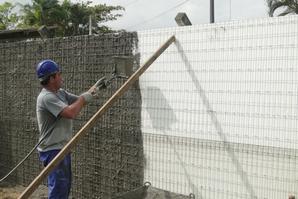
Image By: Termotecnica
A construction worker applies EPS insulation to a home under construction in Brazil.
Brazil’s construction sector is putting up new homes and buildings across the country at a record pace in recent years, but continues to do so with little or no insulation measures built into the walls.
Leaders in Brazil’s plastics industry are asking lawmakers to mandate the use of expandable polystyrene (the raw material for expanded EPS) in new construction, but say it’s an uphill battle despite the energy and construction savings that EPS offers.
“When we talk about civil construction in a developing country like this, government should have a role together with industry to offer these types of advances to the people,” said Miguel Bahiense, president of Plastivida, a trade association promoting the environmental benefits and responsible uses of plastics. “EPS is ready to meet growing demand in Brazil. It’s clear that its impact is significant in terms of savings within the construction projects that have used it.”
Annual energy savings with EPS insulation in walls can top 30 percent in Brazil’s varied tropical climates. EPS is light, shock-absorbent, resistant to compression and water absorption, and offers an ease of use in construction that leads to project cost reductions of 6 to 8 percent, and average savings of 20 percent in total construction time.
EPS consumption in Brazil has grown steadily within the past decade, topping 100,000 tons in 2013, up from 40,000 tons in 2003. Sales between 1999 and 2012 rose by an average of 6 percent per year, with domestic production growing at an annual rate of 6.8 percent over that time, while exports dropped an average of 16 percent each year and imports rose about 4.6 percent per year, according to Brazil’s Chemical Industry Association, Abiquim.
Demand for EPS has also shifted drastically in the Brazilian market in just the past few years, with civil construction usage jumping from 36 percent in 2011 to 56 percent in 2012, surpassing packaging as the material’s top market segment. When used in civil construction, 44 percent of EPS is going toward molded slabs, followed by blocks (34 percent) and panels (10 percent).
Despite the proven savings and broad market applications of EPS, producers say that without federal or state mandates for sustainable, energy-saving features in construction, Brazilian builders may reduce use of EPS in a misguided attempt to cut project costs as the economy slows.
“Brazil’s construction market is very conservative. We also have some regulatory agencies that are archaic, taking a long time to evolve and insist on innovations like this for sustainability,” said Albano Schmidt, president of Termotecnica, one of Brazil’s three top producers of expandable polystyrene, along with BASF and Polímeros Itaquera.
“The way the government can incentivize this segment is to reduce its tax burden. Because EPS is an industrialized product it has a very high tax rate in Brazil,” he added. “They can reduce the taxes for it, and for its applications for construction.”
Annual consumption per capita of EPS in Brazil is now 0.49 kilograms. In Chile, where national building laws require insulation measures, per capita use was 1.21 kilograms as recently as 2012, while in Germany the annual consumption is 3.7 kilograms per person.
According to North American non-profit the Green Building Council, Brazil ranked fourth in its global ranking of sustainable construction for 2013, behind only the U.S., China and the United Arab Emirates. It’s a positive trend that Plastivida’s Bahiense hopes EPS can latch onto.
“We have projects with universities here to show the benefits of using plastics in construction and architecture here,” he said. “There’s no product that can make a bigger impact more quickly in Brazil than EPS.” | 


